DOUBLE EYELID CREATION
ABOUT
Double Eyelid Creation
Asians commonly have a ‘single’ eyelid. Many Asians also have natural ‘double’ eyelids. Having a ‘double’ eyelid is seen as an attractive feature especially in women. This procedure is not done to look more Caucasian.
The best results are when a natural fold is formed that complements the patient’s features. People with double eyelids are seen as friendlier and more approachable, the eyes appear larger and it is easier to apply makeup.
PROCEDURES
Suture Blepharoplasty VS Open Blepharoplasty
A double eyelid is an eyelid that forms a fold when the eye is opened. Patients may undergo an upper blepharoplasty to create a double eyelid. This may be done by suture methods or open incisional methods.
| Suture Blepharoplasty | Open Blepharoplasty | |
|---|---|---|
PROCEDURE |
A quicker operation that causes less swelling. | The skin is directly sutured to deeper tissues, and excess muscle, fat, and tissue may be removed. |
Best Suited For |
Patients with relatively thin upper eyelids. | Patients with thicker upper eyelids. |
Durability |
In thicker eyelids, the suture may cut through tissue, causing loss of fold and recurrence of the single eyelid over time. | The created fold is deeper and more permanent, with less risk of fold loss. |
Scar Visibility |
No visible external scars. | The incision is well concealed in the eyelid crease and invisible when the eye is open. |
Recovery |
Quicker recovery and less swelling. | Takes slightly longer, and swelling takes a little longer to recover. |
INDICATIONS
Ideal candidate for Double Eyelid Creation
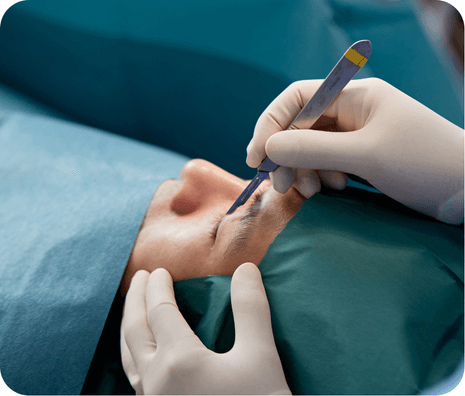
If you have a single eyelid or you have a double eyelid but would like it more prominent, you are a good candidate to consider double eyelid creation.
You will need to be assessed by a plastic surgeon. Your desired outcome will be discussed with you and an appropriate treatment plan can be made.
SAFETY
Risks & Considerations
As with any surgical procedure, certain risks may occur.
- There is a small risk of infection and bleeding.
- Any cut in the skin will leave a mark, but for these procedures they will be very fine and hidden in the eyelid fold.
- The eyelid fold may be lost over time; this risk is higher with suture techniques but can occur with any method.
- Every effort is made to ensure symmetrical folds, though minor differences between both sides may still occur.
🩺 Your surgeon will discuss these risks and measures taken to minimise them during consultation.
As with any surgical procedure, certain risks may occur.
- There is a small risk of infection and bleeding.
- Any cut in the skin will leave a mark, but for these procedures they will be very fine and hidden in the eyelid fold.
- The eyelid fold may be lost over time; this risk is higher with suture techniques but can occur with any method.
- Every effort is made to ensure symmetrical folds, though minor differences between both sides may still occur.
🩺 Your surgeon will discuss these risks and measures taken to minimise them during consultation.
AFTERCARE
Downtime & Recovery

You will experience some swelling, but you will be able to open your eyes.
You shouldn’t apply eye makeup for 2 weeks after the procedure.
HOW TO START
Arrange a Consultation
If you are considering the treatment with our experienced surgeons, you may book a consultation to discuss suitability, options, and the treatment process based on your medical history and goals.
FAQ
Frequently Asked Questions
I’ve had suture blepharoplasty before, but have lost my fold, what should I do?
If you’ve had suture blepharoplasty before, you may choose to try suture blepharoplasty again if you do not want an incisional blepharoplasty. Incisional blepharoplasty would be recommended, but it’s really up to you.
I have a lot of excess skin, can I have suture blepharoplasty?
Incisional blepharoplasty would be recommended so that the excess skin could be removed at the same time.
One of my eyes is bigger than the other, can this be corrected at the same time?
Differences in the sizes of eyes are commonly due to ptosis (drooping) of one or both of the eyes. This can be corrected during your procedure.
Will I be awake during surgery?
The procedure will be done while you are awake, under local anaesthesia. This way we will be able to assess your eyelids during opening and closing.
🩺 A full evaluation with an MOH-accredited doctor is required to determine suitability for the procedure.
*Disclaimer: Results vary according to individual.
GET IN TOUCH
Book Your Consultation