NERVE REPAIR & GRAFTING
ABOUT
Nerves
Nerves are cable-like structures made of bundled fibres that carry electrochemical impulses between the central nervous system and the rest of the body. Sensory nerves transmit signals related to touch, pain, temperature and position, while motor nerves send signals to muscles to control movement.
Each nerve contains individual axons surrounded by the endoneurium. These axons are grouped into fascicles wrapped in perineurium, and multiple fascicles are enclosed within the epineurium.
PROCEDURES
Treatment Options
Nerve Injuries
Nerve injury disrupts electrical signal transmission, causing varying degrees of numbness or weakness. Types of nerve injuries include:
Nerve Injuries
A donor nerve with a less critical function is redirected to restore a more essential nerve.
Primary Nerve Repair
If a transected nerve can be rejoined without tension, repair allows regeneration to proceed at about 1 mm per day.
Nerve Grafting
When the nerve ends cannot be joined directly, a donor nerve graft is used to bridge the gap. The sural nerve, a sensory nerve of the lower leg, is commonly used as a donor nerve.
Cross Facial Nerve Graft (for Facial Paralysis)
A graft is connected to branches of the healthy facial nerve and routed to the paralysed side. After months of regeneration, a second-stage procedure transfers a gracilis muscle flap, which is then connected to the nerve graft.
Nerve Transfer
A donor nerve with a less critical function is redirected to restore a more essential nerve.
Masseteric Nerve Transfer
The nerve supplying the masseter muscle (used for chewing) is transferred to the paralysed facial muscles to restore movement.
INDICATIONS
Who May Need Reconstruction?
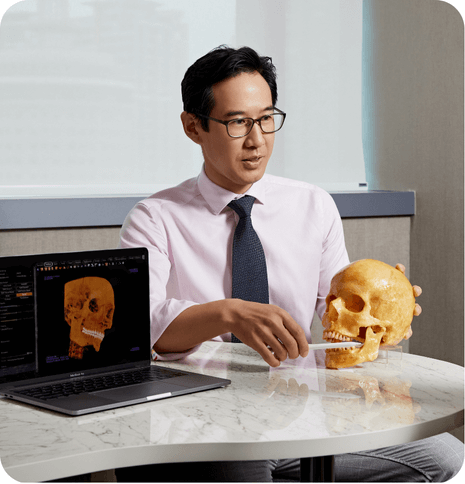
Patients undergoing surgical removal of head and neck cancers that result in functional or structural defects.
SAFETY
Risks & Considerations
- Bleeding requiring transfusion
- Infections
- Flap complications or flap failure
- Need for secondary flap reconstruction
- Revision procedures
- Scars at donor and recipient sites
- Facial asymmetry
- Loss of critical functions (speech, swallowing, or breathing)
- Complications from prolonged bed rest
- Complications related to anaesthesia
AFTERCARE
Downtime & Recovery
- Hospitalisation typically lasts 1–2 weeks.
- Initial monitoring may occur in the intensive care unit or high-dependency ward.
- There may be drains at the donor and recipient sites, as well as tubes to support breathing and feeding. These are removed as recovery progresses.
- Physiotherapists will assist with rehabilitation, including speech and swallowing therapy for tongue reconstruction and mobility training for donor site recovery.
HOW TO START
Arrange a Consultation
If you are considering the treatment with our experienced surgeons, you may book a consultation to discuss suitability, options, and the treatment process based on your medical history and goals.
FAQ
Frequently Asked Questions
How long will I be in hospital?
Most patients stay 1–2 weeks depending on the extent of surgery and complexity of reconstruction.
What support will I receive during recovery?
Physiotherapists will assist with rehabilitation, including speech and swallowing therapy for tongue reconstruction and mobility training for donor site recovery.
GET IN TOUCH
Book Your Consultation